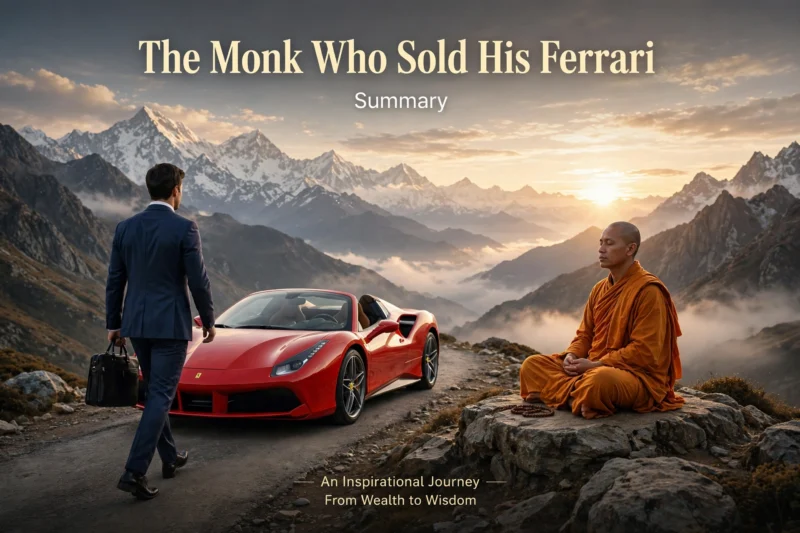
The Monk Who Sold His Ferrari is not just a book. It is a wake-up call for everyone who is running after money, fame, and success — but has lost his peace, health, and happiness in the race.
Written by Robin Sharma, this book tells the story of Julian Mantle — a super successful lawyer who had everything: a big house, a red Ferrari, expensive suits, and fame. But one day in the courtroom, he had a heart attack. That heart attack changed his whole life.
In this The Monk Who Sold His Ferrari Summary, you will learn in just 10 minutes the 7 most powerful lessons that Julian learned from the Sages of Sivana in the Himalayas. If you feel tired, stressed, or lost in life, this book is for you.
Quick Summary: Success without happiness is failure. Julian sold his Ferrari, left his job, went to Himalayas, and learned 7 virtues — Master Your Mind, Follow Your Purpose, Practice Kaizen, Live With Discipline, Respect Your Time, Serve Others, Embrace The Present. That is the whole book.
If you are searching for The Monk Who Sold His Ferrari Summary in simple and easy words, you are in the right place. This The Monk Who Sold His Ferrari Summary will give you the complete story, 7 lessons, and practical action plan in just 10 minutes, so you don’t need to read the full 198-page book to understand its wisdom.
Table of Contents
- 1. The Monk Who Sold His Ferrari Summary: The Story – Who Was Julian Mantle??
- 2. The Monk Who Sold His Ferrari Summary – Lesson 1: Master Your Mind
- 3. The Monk Who Sold His Ferrari Summary – Lesson 2: Follow Your Purpose
- 4. The Monk Who Sold His Ferrari Summary – Lesson 3: Practice Kaizen
- 5. The Monk Who Sold His Ferrari Summary – Lesson 4: Live With Discipline
- 6. The Monk Who Sold His Ferrari Summary – Lesson 5: Respect Your Time
- 7. The Monk Who Sold His Ferrari Summary – Lesson 6: Selflessly Serve Others
- 8. The Monk Who Sold His Ferrari Summary – Lesson 7: Embrace The Present
- 9. The Monk Who Sold His Ferrari Summary – How To Apply These 7 Lessons Today
- 10. FAQs
- 11. The Monk Who Sold His Ferrari Summary – Conclusion
1. The Story – Who Was Julian Mantle?
Julian Mantle was the most famous lawyer in America. He earned $2 million a year. He had a mansion, a private jet, and a shiny red Ferrari. Everyone thought he was successful. But inside, he was broken.
He slept only 3 hours. He drank too much coffee. He shouted at his staff. He had no time for family. He had no peace. One day, while arguing in court, he fell down — a massive heart attack.
After surviving, Julian did something shocking. He sold his house, sold his Ferrari, quit his job, and went to India to find the meaning of life. In the Himalayas, he met the Sages of Sivana — old wise men who lived 100+ years with perfect health and happiness.
They taught him a simple story — a fable — that contains all 7 virtues of an enlightened life. That fable is the heart of this book.
“The mind is like a garden. If you don’t plant flowers in it, weeds will grow by themselves.” — Robin Sharma
2. Lesson 1: Master Your Mind – The Magnificent Garden
Symbol: Beautiful Garden
Your mind is like a garden. If you take care of it, beautiful flowers will grow — positive thoughts, peace, creativity. If you ignore it, weeds will grow — negative thoughts, fear, stress, anger.
Julian used to think 60,000 thoughts a day, and 80% were negative. “I will fail”, “People will laugh”, “I don’t have time”. No wonder he was unhappy.
How To Master Your Mind?
- The Heart of the Rose Technique: Every morning, sit quietly for 5 minutes and focus on one rose. Just look at it. This trains your mind to focus on one thing.
- Opposition Thinking: Whenever a negative thought comes, immediately replace it with a positive one. “I can’t do it” → “I will learn and do it.”
- The Secret of the Lake: Visualize your perfect life for 10 minutes daily. See yourself healthy, happy, successful. Your mind believes what you show it repeatedly.
This is exactly what Atomic Habits also teaches — your thoughts become your habits, and your habits become your life. Control your thoughts, and you control your life.
3. Lesson 2: Follow Your Purpose – The Lighthouse
Symbol: Tall Lighthouse
A lighthouse stands tall in a storm and shows ships the way. In the same way, your purpose shows you the way when life gets stormy.
Julian had money, but no purpose. He was like a ship without a lighthouse — moving fast, but going nowhere.
The Sages said: Everyone has a purpose. Your job is to find it. Purpose is not always a big job. For some, purpose is to be a good father. For some, to teach children. For some, to help poor people.
That is why this The Monk Who Sold His Ferrari Summary focuses on Kaizen — because big change never comes from big steps, it comes from small steps done daily.
How To Find Your Purpose?
Ask yourself 3 questions:
- What work makes me forget time?
- What would I do even if I was already rich?
- What problem in the world makes me sad and I want to fix it?
If you are still searching for your purpose, read our Ikigai Summary — it teaches the Japanese way to find your reason to wake up in the morning. Ikigai + Monk = Complete purpose system.
4. Lesson 3: Practice Kaizen – The Sumo Wrestler
Symbol: Sumo Wrestler
Kaizen is a Japanese word that means “Continuous small improvement.” The Sages said: Don’t try to change your whole life in one day. Improve 1% daily.
Julian wanted to become perfect in one week. The Sage laughed and said: “A sumo wrestler does not become fat in one day. He eats a little more daily. In the same way, you don’t become great in one day. You improve a little daily.”
Kaizen In Daily Life:
- Read 10 pages daily — 3650 pages in a year = 12 books
- Walk 30 minutes daily — Your health will change in 3 months
- Learn 1 new English word daily — 365 words in a year
- Save 100 Rs daily — 36,500 Rs in a year
Small wins, done daily, create a big life. This is the same secret of Atomic Habits — 1% better every day = 37x better in a year.
5. Lesson 4: Live With Discipline – The Pink Wire Cable
Symbol: Pink Wire Cable
In the fable, the sumo wrestler wears a pink wire cable. It looks funny, but it means discipline. A wire cable is made of many small wires. One wire is weak, but together they are unbreakable. In the same way, one small discipline is weak, but many small disciplines together make you unstoppable.
Julian had no discipline. He woke up late, ate junk, never exercised. The Sages taught him: Freedom comes from discipline, not from doing whatever you want.
3 Disciplines To Start Today:
- Wake up 1 hour early: The Sages wake up at 5 AM. That 1 hour is called the “Hour of Power” — 20 min exercise, 20 min learning, 20 min planning.
- Do the hard thing first: The work you are avoiding is the work that will change your life. Do it first in the morning.
- Keep your promise to yourself: If you said “I will walk today”, walk even if it rains. Self-respect comes from keeping small promises.
One of the most important lessons in The Monk Who Sold His Ferrari Summary is this: Time is life. If you waste time, you waste life.
6. Lesson 5: Respect Your Time – The Gold Stopwatch
Symbol: Gold Stopwatch
Time is the most precious thing in life. You can earn back lost money, but you can never earn back lost time.
Julian used to say “I don’t have time.” The Sage said: “Everyone has 24 hours. The King has 24 hours, and the poor man also has 24 hours. The difference is how you use them.”
Time Rules From The Book:
- Don’t waste time on news and gossip: Stop watching 2 hours of news and scrolling 3 hours on social media. That is 5 hours of your life daily.
- Say NO: If something does not match your purpose, say no. Every YES to useless work is a NO to your dream.
- Live 1 day at a time: Don’t worry about tomorrow. Make today perfect. If every day is perfect, life will be perfect.
This lesson connects directly with The Psychology of Money — Money can buy you time, but only if you respect time first. Rich people don’t buy luxury, they buy freedom of time.
7. Lesson 6: Selflessly Serve Others – Yellow Roses
Symbol: Yellow Roses
Yellow roses mean happiness and giving. The Sages said: The happiest people are those who serve others.
Julian was selfish. He only thought about “My case, My money, My Ferrari.” That is why he was lonely. When he started helping others in the village — teaching children, cleaning, cooking — he felt true happiness for the first time.
How To Serve?
You don’t need to be rich to serve. Do these small things:
- Help one person daily without expecting anything back
- Smile at a stranger, say Salam, ask “How are you?”
- Teach what you know for free — even 10 minutes daily
When you give, you receive 10x more peace than money can give.
8. Lesson 7: Embrace The Present – The Path of Diamonds
Symbol: Path of Diamonds
In the fable, the sumo wrestler walks on a path of diamonds. But he is so busy looking at the lighthouse, he doesn’t see the diamonds under his feet. That is us. We are so busy chasing future — “When I get a job, I will be happy. When I get married, I will be happy. When I get rich, I will be happy” — that we miss the diamonds of today.
Today has diamonds: Your mother’s smile, your child’s laugh, a cup of chai, the sunset, your health. If you don’t enjoy today, you will never enjoy tomorrow either, because tomorrow will also become today.
“Never sacrifice happiness for success. Success will come, but happiness must be lived today.”
9. How To Apply These 7 Lessons Today (5-Minute Action Plan)
- Morning 5 AM Rule: Wake up 1 hour early tomorrow. 20 min walk, 20 min reading, 20 min planning. Do it for 7 days, your life will change.
- Write Your Purpose: Write in one sentence: “My purpose is to ______.” Stick it on your wall.
- 1% Kaizen: Pick ONE habit — reading, walking, or learning. Do it 10 minutes daily for 30 days.
- Time Audit: Today, check how many hours you waste on mobile. Reduce 1 hour and give it to your dream.
- Serve 1 Person: Today, help one person without telling anyone. Feel the happiness.
10. FAQs
What is the main lesson of The Monk Who Sold His Ferrari?
Success without happiness is failure. True success is mastering your mind, following your purpose, living with discipline, respecting time, serving others, and living in the present.
Is The Monk Who Sold His Ferrari a true story?
It is a fictional story written by Robin Sharma, but based on real wisdom from Indian and Himalayan sages. Julian Mantle is fictional, but his lessons are 100% real.
Who should read this book?
Anyone who feels stressed, tired, lost, or stuck in a job he hates. Especially students, job holders, businessmen, and anyone who wants inner peace + success together.
How long does it take to read the full book?
Full book is 198 pages, about 4-5 hours. This summary gives you 90% of wisdom in 10 minutes.
Where can I read The Monk Who Sold His Ferrari Summary in Hindi / Urdu?
You can read this The Monk Who Sold His Ferrari Summary in simple English on Xreeder. We have written it in easy words so even students in Pakistan and India can understand it easily.
Want to read the full book? You can check the original book by Robin Sharma on Goodreads – The Monk Who Sold His Ferrari and read reviews from 500,000+ readers. You can also visit the author’s official website RobinSharma.com to learn more about his work.
11. Conclusion
In this The Monk Who Sold His Ferrari Summary, we learned that Julian had everything but was unhappy, and the Monk had nothing but was happy. The difference was not money, it was mindset.
Julian Mantle had a Ferrari, but no peace. The Monk had nothing, but had everything — peace, health, purpose, happiness.
You don’t need to sell your Ferrari or go to Himalayas to find happiness. You just need to apply these 7 lessons in your own life, in your own city, in your own home.
Your action today: Ask yourself — “Am I Julian before the heart attack, or Julian after?” If you are before, today is your heart attack moment — a wake-up call. Change now, before life forces you to change.
Read Next: If you loved this book, you will love The Alchemist Summary — it also teaches how to find your Personal Legend and follow your dreams. And Atomic Habits Summary for building daily discipline.
What is the one lesson from this book that touched your heart? Comment below — we read every comment on Xreeder.