Lifetime Immunity: The President & New Power Structures

Pakistan Passes Historic 27th Constitutional Amendment:
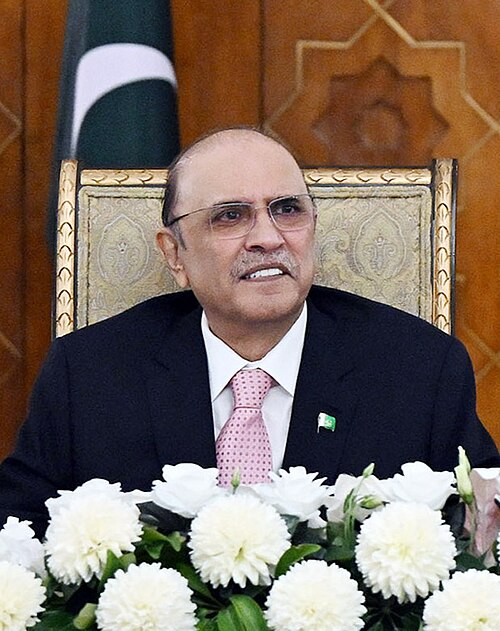
| Zardari in 2024 | |
| 11th & 14th President of Pakistan | |
|---|---|
| Incumbent | |
| Assumed office 10 March 2024 | |
| Prime Minister | Shehbaz Sharif |
| Preceded by | Arif Alvi |
| In office 9 September 2008 – 9 September 2013 | |
| Prime Minister | Yousaf Raza Gillani Raja Pervaiz Ashraf Mir Hazar Khan Khoso (Caretaker) Nawaz Sharif |
| Preceded by | Muhammad Mian Soomro (acting) |
| Succeeded by | Mamnoon Hussain |
| President of PPP-P[1] | |
| Incumbent | |
| Assumed office 27 December 2015 | |
| Preceded by | Ameen Faheem |
| Co-Chairperson of the PPP | |
| In office 30 December 2007 – 27 December 2015Serving with Bilawal Bhutto Zardari | |
| Preceded by | Position established |
| Spouse of the Prime Minister of Pakistan | |
| In office 19 October 1993 – 5 November 1996 | |
| Prime Minister | Benazir Bhutto |
| Preceded by | Lilo Elizabeth Richter (caretaker) Kulsoom Nawaz |
| Succeeded by | Kulsoom Nawaz |
| In office 2 December 1988 – 6 August 1990 | |
| Prime Minister | Benazir Bhutto |
| Preceded by | Begum Junejo |
| Succeeded by | Kulsoom Nawaz |
| Member of the Senate of Pakistan | |
| In office March 1997 – 12 October 1999 | |
| Federal Minister for Investment | |
| In office 1995–1996 | |
| President | Farooq Leghari |
| Prime Minister | Benazir Bhutto |
| Federal Minister for Environment | |
| In office November 1993 – 1996 | |
| President | Farooq Leghari |
| Prime Minister | Benazir Bhutto |
| Member of National Assembly of Pakistan | |
| In office 18 November 1985 – 9 March 2024 | |
| Succeeded by | Aseefa Bhutto Zardari |
| Constituency | NA-207 Nawabshah-I |
| Personal details | |
| Born | 26 July 1955 (age 70) Karachi, Federal Capital Territory, Dominion of Pakistan |
| Political party | Pakistan People’s Party |
| Spouse | Benazir Bhutto(m. 1987; died 2007) |
| Children | Bilawal Zardari Bakhtawar Zardari Aseefa Zardari |
| Parent(s) | Hakim Ali Zardari[2] Bilquis Sultana |
| Relatives | See Zardari family |
Date: November 10, 2025
Category: Pakistan Politics, Constitution, Breaking News
Author: Syeda Naqvi.
🇵🇰 Introduction:
A New Chapter in Pakistan’s Constitutional History
In a landmark move, the Government of Pakistan has passed the 27th Constitutional Amendment Bill, 2025, reshaping the nation’s political and institutional framework. This amendment, approved by the Senate with an overwhelming majority, introduces major constitutional shifts—including lifetime legal immunity for the President of Pakistan, the restructuring of the military command system, and the creation of a new Constitutional Court.
The bill, comprising nearly 60 clauses, is being called one of the most transformative amendments since the 18th Amendment of 2010.
🏛️ Key Highlight: Lifetime Legal Immunity for the President
Under Article 248 of the Constitution, the President and Governors previously enjoyed legal immunity only during their time in office. The new amendment changes this provision dramatically — granting the President of Pakistan (Sadr-e-Pakistan) immunity from any criminal proceedings for life, even after leaving office.
This means the President cannot be:
Arrested or detained in any criminal case
Tried in any court of law, even after their tenure
Subjected to prosecution under ordinary criminal law
This clause was reportedly added at the request of key coalition partners and has become one of the most debated parts of the amendment.
Critics argue it could weaken accountability, while supporters claim it ensures institutional stability and protects the head of state from political victimization.
⚔️ Reforms in Military Command and Defence Structure
Another major shift appears in Article 243, concerning the command and control of the armed forces.
The amendment:
Abolishes the post of Chairman Joint Chiefs of Staff Committee (CJCSC)
Creates a new position: “Chief of Defence Forces (CDF)” — the highest uniformed authority overseeing all three branches of the military
Retains the President as Supreme Commander of the Armed Forces, but with appointments to be made strictly on the Prime Minister’s advice
Analysts believe this move consolidates command authority under one structure and further formalizes the Prime Minister’s role in defence appointments.
⚖️ Judicial Reforms: Establishment of a Constitutional Court
The 27th Amendment also proposes the formation of a Federal Constitutional Court (FCC), a separate body to deal exclusively with:
Constitutional interpretation
Fundamental rights cases
Disputes between the federation and provinces
This new court will limit the suo moto powers of the existing Supreme Court and create a dual-layer judicial system.
Judges for the Constitutional Court will be appointed through new criteria, reducing the required experience from 7 years to 5 years in the High Court.
💰 Federal-Provincial Financial Adjustments
Amendments to Article 160 (NFC Award) aim to revise the financial relationship between the federal government and provinces.
The new clause allows periodic review of resource distribution formulas, which may shift greater fiscal authority to the centre or introduce new performance-based sharing mechanisms.
📉 Reactions and Political Impact
The passing of the 27th Amendment has sparked mixed reactions across Pakistan:
Supporters hail it as a modernization of the constitution — bringing clarity, stability, and a more defined power structure.
Opposition parties call it a “power-grab amendment,” claiming it centralizes control in the hands of the executive while weakening judicial independence.
Legal experts have warned that lifetime immunity for the President could set a controversial precedent, making future accountability nearly impossible.
🔍 Analysis: What It Means for the Presidency
The President of Pakistan remains the symbolic head of state, but this amendment redefines the office:
- Increased Protection – Lifetime immunity shields the office from political or legal challenges.
- Reduced Executive Influence – Real administrative power continues to rest with the Prime Minister.
- Ceremonial Balance – The President retains formal authority over appointments and ceremonial duties.
While constitutionally strengthened in protection, the role of the President may become more symbolic than ever in the practical governance framework.
🕊️ Conclusion:
A Turning Point for Pakistan’s Future
The 27th Constitutional Amendment Bill, 2025, represents a turning point in Pakistan’s political evolution.
By redefining the authority of the President, the judiciary, and the military, it lays down a new power balance that will shape the country’s governance in the years to come.
Whether this change ensures stability or fuels controversy will depend on how responsibly these new powers are exercised — and how the people of Pakistan respond to this new constitutional order.

References
Gupta, K. R., ed. (2006). India-Pakistan relations with special reference to Kashmir. New Delhi: Atlantic Publ. and Distributors. ISBN8126906723. “Govt wants to double president’s salary”. The Express Tribune. 29 May 2018. “Data” (PDF). www.na.gov.pk. Retrieved 9 June 2020. “Pakistan moves to roll back presidential powers”. Los Angeles Times. 2 April 2010.
Notes
The salary of Prime Minister of Pakistan is 2 Lakhs 1 thousand per month (9,50,574/month equivalent US$1,323) inclusive of all allowances and exclusive of the taxes, He is not receiving any payment from government. The salaries of federal ministers, state ministers, senators, high court judges, and president is more than the prime minister of Pakistan.[2][3][4]Urdu: وزِیرِ اعظم پاکستان, romanized: Wazīr-e-Aʿẓam, lit. ’Grand Vizier‘, Urdu pronunciation: [ʋəˈziːr-ˌeː ˈɑː.zəm]
Internal Links
- Amendments to the Constitution of Pakistan — historical overview of constitutional amendments in Pakistan.
[Link text suggestion: “Amendments to the Constitution of Pakistan”] - Article 243 of the Constitution of Pakistan — details the section being amended concerning the command structure of the armed forces.
[Link text: “Article 243 – Armed Forces command structure”] - Federal Constitutional Court (Pakistan) — the new judicial body created under the amendment.
[Link text: “Federal Constitutional Court (Pakistan)”] - Legal immunities in Pakistani law — discussion of legal immunity for high-office holders, relevant for understanding the lifetime immunity aspect.
[Link text: “Legal immunity in Pakistan”] - Civil-military relations in Pakistan — provides background on how the military and civil realms have interacted historically, useful for implications of the amendment.
[Link text: “Civil-military relations in Pakistan”]
External links
- http://www.president.gov.pk/

1 comment